Monday, October 30, 2006

A brief history of the Kildonans

A recent visitor to my blog, who is no doubt a proud Kildonanite, took pains to inform me as to the history of his fine neighborhood after having read my post about whether or not Kildonan was a separate entity from the city of Winnipeg. Here is his comment:

You are wrong in saying that Kildonan was not a separate area from Winnipeg. There was a municipality of Kildonan from 1875 to 1914. In 1914 this divided into East and West Kildonan in 1914, two separate municipalities. In 1922 Old Kildonan separated from West Kildonan becoming a separate municipality. In 1925 North Kildonan separated from East Kildonan becoming a municipality. In 1957 East Kildonan became a city while West Kildonan became a city in 1961. In 1972 the four Kildonan’s became part of Winnipeg along with the cities of St. Boniface, St. Vital, Transcona and St James Assinobia with the municipalities of Fort Garry and Charleswood along with the town of Tuxedo and the old city of Winnipeg. -Jim Smith

Thursday, October 26, 2006

The Virtues of Ethanol

Yesterday on ALFA I posted a silly little GIF animation that was a lot of fun to make (if a bit time consuming). Today I tackled an even longer project.

Tuesday, October 24, 2006

Instant Loan Article

There’s a world of bad choices out there for anyone with a bit of credit. Everywhere you look someone is encouraging you to lay out your hard earned money for a bit of instant gratification. And with the explosion of loan shops and once-in-a-lifetime credit offers it’s easier than ever for consumers to get their hands on borrowed cash.

Bill C-26 was tabled in Ottawa earlier this month to allow provinces to cap the amount payday lenders can charge for their services. It’s a measure intended to bring a bit of sanity back to the feeding frenzy creditors have made of our enjoy now, pay later consumer culture. But the proliferation of these despicable loan companies is a built on a popularity of their services, and despite any cap that may be imposed their unsavory practices will continue as long as customers demand it.

According to Statistics Canada a near majority of Canadians (47 per cent) spent more than their pre-tax income in 2001. A 2004 Industry Canada report described consumer bankruptcies as being on a “long-run upward trend” stating that there were “more than two-and-a-half times as many consumer bankruptcies in the 1990’s than during the previous decade.” This same report says that from the beginning of 1989 to the end of 2003 the debt-to-income ratio increased from 73.8 to 103.2 per cent, while the savings rate declined from 14.1 to 1.3 per cent.

In isolation any number of conclusions can be drawn from these numbers: that real earnings are down since the end of the 1980’s, that the cost of living is higher, or that taxation and economic policy have become a greater burden. For example decreases in post-secondary education funding in the early ‘90’s have seen today’s students take on a greater financial burden for the same amount of education a student in the 1980’s would face.

However one cannot simply blame government policy for this epidemic of personal debt. Equal partners in the decline of prudent and reasonable spending habits are the increasing ease of acquiring consumer credit, and a growing lack in the good judgment of the loan seeker.

In many cases the public has simply allowed savvy advertising firms and finance companies to take control of their financial decisions, forgoing an educated and balanced approach in the face of easy credit. In essence they have placed a great deal of trust in people who’s primary goal is to separate them from their money. There is no public education strategy or meaningful political action to counter the voodoo-like lure of modern marketing, and so the cycle of debt continues to grow unchecked.

There is another way. Despite having lived near the poverty-line for the balance of my adult life I have never found myself in dire financial straights. Having made a conscious decision to live within my limited means has enabled me to discover a path to living that avoids the trap of becoming a slave to creditors and the notions of class and convenience instilled by advertisers.

I am certain that my near asceticism won’t appeal to most, and I’m not advocating for a monastic life for the masses. But I do believe there is a lot more to be gained from practicing some prudence than any television commercial or payday loan agent would have you believe.

While it is true that many of my clothes were once someone else’s and that I’m not very up-to-date on the city’s finer dining establishments I do retain the freedom to make choices for myself without having to consult with my bankers, and am comfortable in the knowledge that my purpose in life has not become to my next car payment. I take the time to think, to breathe, and to be thankful for the things I have rather than run up another hill of debt when the next must-have item saunters past in a coat of shiny cellophane.

Having one’s thumbs screwed by unhappy collection agents and getting gouged at the instant loan shops is no way to get by. The true path to financial freedom is to balance what is truly needed against unnecessary wants disguised in a cloak of affordable monthly installments.

Sunday, October 15, 2006

Evolution of the Middle West

The core of the continent
after a hundred years of explosive growth
when entrepreneurial Europeans
bought off the native people
with glass beads and Bay blankets
is dying-off like old star.

Where once energetic pioneers
surveyed the windswept plains
huddled near the fire
in rustic sod huts
and languished in the humidity
of their vibrant young cities
today they wander off west
to the new capitals of capital.

Oh, how we bemoan our fate!
Mystified we beat the bushes
looking for a solution
to the ennui and economic despair
that teaches our young and educated
to fly away.

“We can be great again”
the optimists opine
the right mix of policy and publicity
can recapture the spirited energy
that made our cities the envy of the world
in the year 1908
just build some bus lanes
and turn empty warehouses
into condos
all will be well again.

But wide open skies
and clean water
are not the draws they once were
prosperity depends on how much bacon
one brings home,
in today’s world
the workers are not tied to agriculture
or the modest industries of the middle-west.

The big cities capture excitement
romance and adventure
like ours once did
they have mountains, money
and movie stars
we have winter, urban decay
and entire neighborhoods
full of dismal poverty.

Let your children go
into that brave New West
ours is a land of opportunity spent
where our very existence
depends on generous payments
from the national coffers
like a once glorious sub-Saharan state
our wealth has dried up and withered
there are not enough natural reasons
to fuel future growth,
let it be so.

Wednesday, October 11, 2006

Maintaining the Status Quo: A Classic Disclaimer Rant

Economics is a minefield for the uninitiated. Posing as a science it is in fact a more mystical pursuit whose main objective is to hold power for those who keep the money. We the ordinary, un-enshrined members of society: the artists, the students, the workaday types are at the mercy of a system that keeps our thumbs screwed tight and does not allow for dissent. No matter what your feeling on the matter rent must be paid and work must be done to accommodate the idea that we all must earn a wage and therefore “contribute” to the economic wealth of our nation.

In the absence of a truly pan-national ethos Economics is the closest we can come to agreeing on what the purpose of life might be. Various theorists and political enterprises have tried to shape how this modern creed is practiced, those with an interest in social justice and the working class tried to infuse economic policies with a collectivist flair, but for the most part the weakness and wickedness in man (sexist pronoun intended), his desire to seize power and dictate, won over the more noble ideals of Bolshevism, leaving a bitter taste in the mouth of those who would wish to organize economies for the benefit of all.

What is left is the trickle-down theory, the grossly unfair policies of the powerful that insist that individual wealth is the greatest thing to which we can aspire, a right that is enshrined in tax and corporate law to ensure that it continues indefinitely. The real victory of the Cold War in this context was the victory of billionaire industrialists (i.e. war makers) over every day people. The “winning” system of economics did not end up helping its poor, in fact it barely felt the need to pay them lip service. Its goal was to crush the idea that wealth should be shared, that its methods should be questioned, that “progress” should be measured by any other standard than profit.

Now we see that those who control this system lie to us outright and arrogantly send their armies out to die for an ideology and/or faith they do not wholly understand. The philosophy that guides these leaders is one of privilege and isolation. They believe that the fibs they tell are for the greater good, not really understanding that “the greater good” means anything other than what is best for their own cabal of friends and associates.

Granted it is difficult for anyone to become enlightened enough to see beyond one’s own ego. Their are monumental questions to ponder before one can contemplate with sobriety the shaping of human history. But these questions are never asked. The brains of the masses are subdued by toxic images and ideas—taught to conform, rather than to think. Thus those who attain power are much like the majority: absorbed in self-interest, and holding true to unquestioned ideologies even in the face of evidence that these beliefs are a tremendous failure in practice.

The basic truth, that modern representational democracy is generally a huge failure, is masked by creating a middle-class that can succeed despite the odds and can be lulled into believing that their success can be shared by everyone; that their success should be the goal of everyone. The gross unfairness, the inhumanity of the engine that generates wealth for the great Northern nations is effectively hidden in dreams of making it big and in the struggle for personal economic security. When necessary wars are engineered to keep the public imagination from straying too far.

No-one is encouraged to envision a society that has every basic need met, so that the purpose of work is really just to maintain a sustainable and healthy slow or no growth model of human existence. We must grow, grow, grow, more like a cancer than anything. We must progress at all costs. Everything this year needs to be smaller, faster and more cunningly designed than the things we needed so badly last year. Everyone must be kept busy, busy, busy. So much to gather up and exploit before we expire. When we are idle the guilt and worry can consume us, so thoroughly programmed we have become to be “productive.”

Even our gods are explained in absolute terms, and their wishes spelled out in ancient texts which cannot be questioned. Real lives are destroyed, and Earth herself condemned on the basis of archaic prophecy. No one believes that religion can or should be reformed by anyone but God’s own representatives; however the age of mysticism and prophecy is over so we live with impractical dogma that cannot be re-written, and unimaginative leaders who use this dogma as a power structure rather than an instructional model to free people of their worldly constraints. Heaven is a place where nothing happens, Earth is only the way station to this eternal nothingness, and what we do here matters little as long as it is done in the name of God.

What is wrong with us, do we truly need catastrophe to change how we govern ourselves? Is Armageddon the only way to open the door to a new understanding?

Thursday, October 05, 2006

Ode to an Autumn Night

This is a short poem about a beautiful autumn night I wrote last night after walking home from Osborne Village.

fall dapples
the waters of the assinaboine
in reverse
dark water, bright leaves
perfect calm
middle of the bridge

trees are every colour
lit by streetlight
afire of orange, yellow
red and brown
breathing in
mysterious night

glorious decay
life giving into itself
for another season
changes in the stars
as Earth
prepares to sleep

Wednesday, September 27, 2006

Is this what Jesus would do?

Here's another article I published in the Free Press.
A public craving for revenge in the wake of the murder of University of North Dakota student Dru Sjodin was satisfied last week when a jury of 12 decided to impose the death penalty on Alfonso Rodriguez, Jr.

Although the jury unanimously agreed that Mr. Rodriguez suffered from a “mental disorder or impairment” and that a sentence of death would devastate his immediate family they ruled in the end that he was still capable of making “good decisions” and therefore deserved to lose his life for the horrific rape and murder of the attractive young woman. They made this decision despite the fact that Mr. Rodriguez, who feared he may continue to pose a danger to society, had asked to remain in prison following his mandatory release.

The American right to commute a sentence of death upon those who commit murder is an anomaly in the Western world, where among the nations of North America and Europe only Belarus, Guatemala, Belize and a handful of Caribbean countries actively retain the practice. Among countries considered to be “fully developed democracies” only the U.S., Japan and South Korea impose the death penalty. It has not been shown to act as a significant deterrent in states where it is practiced, and its purpose must therefore be seen primarily as an act of vengeance.

In the case of Mr. Rodriguez, according to jury foreman Terry Heuer, "There was some feeling, 'What mercy was shown for Dru?' Life in prison wasn’t punishing him because he got along fine in prison." It is astonishing enough that a group of 12 people could agree to execute an individual they regarded as mentally impaired, but to do so because prison was not deemed enough of a punishment is appalling.

In the wake of this decision there has been talk in North Dakota and Minnesota of re-instating capital punishment, where it has been suspended since the early part of the last century (Mr. Rodriguez was convicted on a federal statute and therefore eligible for the death penalty.) The reversal would be a tragic result, especially in light of the fact that Mr. Rodriguez should never have been allowed to re-enter society unsupervised in the first place.

There will no doubt be an appeal in this case, and it may be years before Mr. Rodriguez faces lethal injection (a practice which is currently facing challenges in some U.S. jurisdictions as being counter to the eighth amendment abolishing “cruel and unusual punishment”). But the question of how a randomly selected group of people, most if not all of whom would identify themselves as Christians, could reach the unanimous decision to execute another human remains puzzling to say the least.

More than any other county in the democratic world the United States identifies itself as a nation under God, and yet they continue to practice, quite publicly, the most reprehensible form of retribution, short of torture, known to man. To paraphrase a currently popular American sentiment: Is this what Jesus would do?

Monday, September 25, 2006

Peg City Panorama

This is an image I made with my camera's panorama feature and a few Photoshop filters.

Thursday, September 21, 2006

Video Games and Violence

This is an opinion piece I wrote after having read a report on video games and violence. It was politely rejected, but I'm interested if anyone has any further opinions on it, since I'm not much of a gamer myself, just someone who believes that games don't make killers.

In the wake of the most recent school shooting in Montreal I read a report seeking a connection between violent video games and the actions of the assailant. In my opinion asking if video games cause violent behavior is a bit like asking if drinking alcohol causes car crashes.

The vast majority of people who play video games do not go on shooting sprees, just as most people who drink copiously do not attempt to drive themselves home afterwards. Nonetheless there will always be a portion of society who is at risk to engage in potentially deadly or murderous behavior, albeit for vastly different reasons.

In the case of one who chooses to drink and drive society typically deems the driver fully responsible for his actions, but in the case of killers who play video games—which millions enjoy daily without serious thoughts of actual murder—we tend to seek a cause in the form of entertainment. When someone is killed senselessly as a result of a drunken driver the media seldom digs for mitigating circumstances, yet in the case of random homicide(s) we are never satisfied by the possibility that this was just a sick person who could not find the help they needed; or worse that there was nothing anyone could have done to prevent tragedy.

Perhaps our helplessness and disbelief in the face of an irrational murder obliges us to seek a deeper motive, but I think we do ourselves a great disservice by blaming TV and videogames for real violence.

The tendency to see violent entertainment as a predicate for acts of violence is disingenuous. Violent rampages have happened and will continue to occur with or without the aid of a Playstation or a library of Schwarzenegger films. Senseless violence was with us before every case of it resulted in a media circus, a Hollywood movie and a bestselling book.

Indiscriminate acts of violence are committed by people with disturbed minds, whether the result of an abusive past, family problems, a mental handicap, substance abuse, a sociopathic personality or a combination of these. This is not to say that murderers do not gather influence and enthusiasm from violent forms of entertainment, but I don’t believe that an unquenchable yearning to act violently is visited in healthy people who partake in such diversions.

As for the question of whether these games promote a desensitization in the minds of youth—which may or may not lead to a potential to act out violently—I think it’s pretty clear that where and how one is raised is a far more critical factor than the games one plays. Before videogames children played war, wrestled with one another and engaged in violent sports like hockey and football. For most these games were and remain a healthy outlet for the aggressive phase of childhood and early adulthood that is experienced by many. Videogames are no different; despite the gore since most players are capable of realizing the blood and guts for what it is: a fantasy.


The real question should not be “Do videogames cause violence,” but rather how we as a society treat those who are vulnerable to acting out violent fantasies. Are we sensitive enough to the calls for help they often make before acting? Are we listening to what they are expressing and recognizing the signs? Are we offering treatment and ensuring that they are housed in a safe, nurturing environment?

To blame videogames for an act of murder is to abdicate our responsibility for what we could have, and should have, done to prevent it. Censoring games and violent programs will not do much in the end to stem the violence. What really needs to be done is to provide the proper care for those in our society whose mental and/or spiritual states lead them to believe that killing others is an answer to their problems.

Monday, September 18, 2006

Thinking in Happy Thoughts: A Poem

In the middle of this downpour
a whole bus load of
small children appear
wearing a rainbow
of bright coats and
rubber boots.

Girls carry Hello Kitty umbrellas
boys jump high in the air
and come splashing down
on every puddle they meet
all one can hear
is laughter.

Open the sky, let it rain
they will find imagination
in the shimmering streets
a rivulet of storm water
draining away becomes
the mighty Amazon.

Wet and windy days
foretell the end of summer
but for these explorers
it is something new
and wondrous
to discover.

A Nasty Letter I Object Strongly To

Here's a short, nasty letter that appeared in today's Free Press and my response:

Disgusting article

Re: A tearful plea for son's life (Sept. 13).

I found the article about this crazed, animal-like man (Alfonso Rodriguez) to be very disgusting. I do not know why any members of this family should be allowed any time or space in any media to claim his actions were in any way not his own fault.

ROBERT S. PORTER

Winnipeg


Robert S. Porter’s venomous letter regarding “crazed, animal-like man” Alfonso Rodriguez displayed a surprisingly uninformed and unjustifiable opinion in light of what is known about Rodriguez’s mental health, and the fact that Mr. Rodriguez himself asked not to be released from prison. Not only does Mr. Rodriguez’s mother have every right to plea for mercy on his behalf, but given the facts of the case there should be no question as to whether the death penalty is warranted. Mr. Rodriguez and his victim were let down by the prison system that set him free; he does not deserve a state sanctioned death, nor the condemnation of ignoramuses like Mr. Porter.

Saturday, September 16, 2006

Return of the ASCL

As a rainy day project I decided I'd continue on with some more of the ASCL logos I originally created as a sports-graphics-obsessesed, nerdy youngster. These ones are probably two of my all time vaves. I liked the names of the teams, and the fact that they were just pictures with no letters. Here is a link to the original ACSL post, in case you don't know, or don't remember, the the background of this post. The second post of logos is here.

Thursday, September 14, 2006

here/now

>sinewy
legs pushing pedals
nowhere is here
rutted gravel road
hands on handlebar
eyes ahead
riding hard
Nowhere in mind

>sky
gusty twisting wind
now is with
now against
sun bursts through
stubble prairie
autumn brown yellow
shadow and relief

>freedom
no banshee bankers
chasing after
commission-free
off the clock
only clouds
sailing by
like hulls of cumulous ships

>>here
a park bench
far enough away
from the workaday city
old Ukrainian man laughs
when his rheumy black dog
snuffles the sandwich
“better watch your lunch”

>>now
is forever
an opening in time-space
late summer breathes
nowhere to be
but here
damn glad
to be alive Today

Monday, September 11, 2006

Reflections on 9/11

Today is a horrible anniversary. The events of five years ago plunged the United States and its allies into a nationless “war on terror” against an invisible enemy. At that time the world was sympathetic and vengeance was swift. The terrorists’ Taliban harbourers were smart-bombed into hiding, while anyone carrying a suspicious passport was unceremoniously incarcerated in foreign jails that precluded the possibility of American style justice.

All of a sudden it was no longer possible to afford the prisoners of war the same rights America had demanded for its P.O.W. populations during previous conflicts. This war, we were told, was different. As much as America knew that torture was an ineffective method of gathering useful intelligence, as much as its citizens were horrified to think that Americans kidnapped by jihadists were suffering from similarly inhumane treatment, the American government was unrepentant in its use of such tactics.

The media glossed over all but the goriest and most obvious reports of mass misconduct and focused instead on how much the world had changed since that fateful day when four commercial jets were repurposed as deadly missiles. No perspective was ever offered on the loss of life compared to the staggering cost of the wars fought as a result. No one seemed too concerned about the amount of freedom that would be sacrificed in order to protect against unverifiable threats at every turn. That summer thousands more Americans died behind the wheel of an automobile, were murdered in gang violence, killed themselves for want of affordable psychiatric help. But America's government and its blood thirsty, lap-dog media saw only the need to feed the citizenry newsworthy threats of imminent terrorism, much as an arsonist might continue to douse an inferno with gasoline.

Our own media began to call us cowards and ostriches because we refused to recognize this new threat to our peace and security. They chided us for our anti-American sentiments, believing that we had let a hatred for Bush blind us to the virtues of his imperialistic assault on Baghdad. They urged us to act before a terrorist took out a Tim Horton’s in Oakville and really opened our eyes.

But I remain convinced that there is no practical way for these terrorists to destroy us. At most they can continue to develop plots that may kill several hundred, or if they are lucky, several thousand in a single shot. The more complex and ambitious the plot, the more likely it is to be discovered and foiled. They can never wage a conventional war against us, never take the soil from under our feet. Our best response isn’t to pretend nothing has happened, but nor is it to take up arms against unseen threats.

If we allow fear to guide the way we live, if we squander liberty for the occasional dramatic instance of violence, rather than maintaining our stoicism at the cost of a few innocent lives, then we are lost. What we must do is stand tall and face fear, not with vengeance in our hearts, not with the idea that we can rout out evil with enough weaponry, but with the belief that life goes on despite tragedy and despicable acts of hate. How can one possibly hope to stop a tide of suicide bombers with a show of force? Antagonizing terror only spurs terror. It is only in re-evaluating our actions, in showing that we are not afraid, that we can truly conquer the beast.

A war is what the billionaire industrialists want, for it reinforces the entitlement they feel to be lords of us all. A war is what the pockets of extremists in far away lands want, for it justifies their right to exist and to claim that their god is threatened by Western values. But a war doesn’t do much good for the average Canadian. It does not reverse the sentiment of a disenfranchised lot who may be plotting to blow-up Parlaiment; it does not give us hope that the valiant efforts of our Armed Forces will result in the victory of good over evil. It only serves to divide us and weaken our resolve.

The media and government can reprimand us for mistrusting our American allies, but they are wrong to attribute our wariness to some abstract concept of “us and them.” The point of anti-American sentiment is not that they are richer, more conservative or simply different from us. It is that their government and its power hungry supporters use their sense of moral superiority, their continuing belief in Manifest Destiny and the power of their arms and economy to dictate their terms to everyone else. Must we subscribe to a skewed world view in the name of trade and good business? Must we bow to bad ideas because it is the diplomatic thing to do? Need we let a misbegotten and highly politicized concept about what terrorism can achieve transform us into a nation of cowering sheep?

On this, the fifth anniversary of 9/11 what we need to do is to continue to voice our discontent, to say this "war" is not helping, that these ideas about terrorism do not present a useful and workable solution to the problem. Yes it is terrible that thousands of innocents have died, and it is terrible to contemplate the loss of thousands more. But what is even sadder is the idea of giving up our freedom and human rights to a ruling class that shows almost as little respect for its own citizens as it does for its enemies.

Friday, September 08, 2006

Word Fight

Last weekend on the ALFA Blog we had a discussion about the power of words, specifically as they relate to the extreme right-wing opinions of Sun columnist Michael Coren, and others of his ilk (the specific post is here). While there were some that dismissed the power of Mr. Coren’s words because they were based on ignorance and prejudice, I argued that his voice needs to be shouted back at because there are many dumb and hateful people who use his bigotry to fuel their own misguided beliefs.

This same reasoning is what led me to attack last weekend’s editorial by Dallas Hansen (my rebuttal is published with some amendments to the original--posted below--in today’s Free Press.) Whereas I will not accuse Mr. Hansen of being a right-wing extremist idiot on the level of Mr. Coren, he did, in his most recent editorial, make some very wrong-headed generalizations about a marginalized population.

Although I cannot claim to be an expert on the plight of the poor I do understand that their problems are not based primarily on laziness or the existence of welfare, and I could not stand by and let Mr. Hansen, a young and reasonably intelligent man like myself, be the only voice on the matter. He certainly is entitled to his opinion, but when he tries to convince the rest of Winnipeg, via the Free Press, he needs to be countered. His words had too much potential for damage in a city that already ignores its poor, lest it be to make bigoted remarks about them.

Currently the mayor is on a re-election campaign, and with no real brand-name competition he seems to be a lock. His much publicized solution to poverty and the crime it engenders is to increase the police presence on the streets of Winnipeg. This will mask the problem by incarcerating the under-privileged’s most obvious sub-group: the joy-riding car thieves and other petty criminals, but will do little to change the root causes.

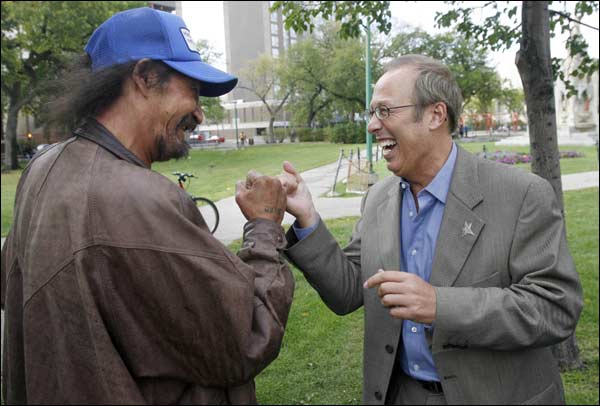
Mayor Katz seems to be taking a page out of the book of Bush’s Republican re-election campaign whose unofficial slogan is: “Win ‘em over with Fear.” Like Bush Katz has no real interest in the poor, despite today’s publicity shot of him handing some coins to a panhandler. He is for big business and SUV driving soccer-moms; he represents, with no apologies, the suburban population of this city, the people who don’t come downtown because they fear muggings and vehicle break-ins. And in a sense that’s fine because the suburbs is where most of our population lives, but the truly sad thing is that Sam has no vision. He’s a respected business man with enough of a name that he is electable, and little more. Too bad for Winnipeg, especially those who could benefit from a more compassionate and dedicated mayor with some real ideas on how to improve this city for everyone's benefit, including the least among us.

**(The photo of Katz and Winnipeg citizen Danny Spence was taken by Mike Aporius and published in the Free Press)

Tuesday, September 05, 2006

Response to an Idiotic Editorial

This is a rebuttal I wrote in response to a horribly prejudiced and idiotic editorial in Saturdays Free Press. The original editorial can be referenced by clicking the linked title of this post

In Saturday’s editorial in the Free Press “Willpower the best weapon against poverty” Dallas Hansen insists that eliminating welfare for “able-bodied workers” is the key to getting poor people to realize the value of their time and efforts through employment. Though his ideas are valid to a certain extent much of Mr. Hansen’s argument is grossly unfair, extremely arrogant and terribly naive.

Mr. Hansen seems to believe that every “able-bodied” person is born with the same amount of will, the same ability to conform, and the same capability to overcome mental and physical illness in pursuit of an honourable, workaday living. He mentions the time he went to a temp agency on a lark and did eight hours of day-labour. It was easy, he claims, and “fun”, to get hired on to do a day of hauling trash. He is certain that, had he chosen to, he could have come back the next day and found an equally amusing job to do for minimal wages.

Sadly there are many who’s circumstances prevent them from enjoying the benefits of our glorious Capitalist system, even with a physically capable body and an abundance of low paying jobs.

For one thing mental illness is a gigantic and often unrecognized barrier to attaining the benefits our society can bestow. This illness may not manifest itself as something we recognize and/or sympathize with. Whereas I doubt Mr. Hansen could reasonably object to a schizophrenic or severely mentally handicapped individual receiving aid from the state I wonder if he realizes that chronic depression and a myriad of other undiagnosed problems are often to blame for an inability to thrive in our miracle economy. Hard work and pride in a job well done can be a tonic for some people suffering these maladies, but they do little in the long run to alleviate the root causes of mental illness.

As for the ever-present evils of substance abuse Mr. Hansen states that the solution is to simply stop drinking and doing drugs. This is a startlingly ignorant position, given that even the wealthiest and most educated people in our society can become entrapped in addiction and ruin their lives as a result. Among those who suffer from drug and alcohol dependence are many whose own families have disowned them, who will never be considered reliable or capable of holding down a job, who cannot afford the uninsured medical and/or psychiatric help they need to get clean. They are caught in a downward spiral with no rope to hold on to.

Mr. Hansen also makes the point that those receiving welfare waste their cheques on pre-packaged low-nutrition food. As savvy as he is he does not perceive the lure of convenience food, and does not seem to realize that an undereducated member of society is much more vulnerable to the manipulation of those who offer bad choices (tobacco companies, fast-food establishments, etc.) than someone who has had the advantages. Furthermore, he does not stop to consider the very real possibility that the welfare mother who feeds her child Pizza Pops may not have the basic cooking skills required to prepare a more economical and healthy meal.

Finally, and perhaps most objectionably, Mr. Hansen implies that it is in the best interest of social workers and agencies who support the impoverished to maintain the welfare rolls. This is patently absurd. Those who work in social services do not do so because it is a comfortable living. They take on highly emotionally draining work and visit desolation daily. How dare Mr. Hansen accuse them of cashing in on pity. I am betting that there are far more social servants of all stripes who would prefer a lighter case load, and more happy endings to a fatter cheque as a result of growing despondency.

There can be no doubt that a certain number of welfare cases would be better served by doing as Mr. Hansen suggests, which is finding pride and accomplishment through daily labour. But his overly-simplistic notions on the matter are discriminatory, insulting, and ultimately do a great disservice to our nation’s poor and those who wish to help them in their struggle to escape destitution and despair.

Friday, September 01, 2006

Travelling Riverside Blues


Last weekend my friend Mike (a frequent vistor to this blog) and I had a discussion about Led Zeppelin lyrics. Mike was surprized to find out that some great lines he had always attributed to the pen of Robert Plant actually belonged to old bluesmen. In fact, I told him, Robert Plant is probably the single greatest rip-off artist of all time. Come to think of it, perhaps "single greatest rip-off artist" is a bit strong--in this day of mashing and sampling it's quite possible that the title might be disputed by Puff Daddy, or any of a dozen or so other artists who have built a whole career on reusing previously recorded material. Anyway I can't think of anyone else who borrowed lyrics so unabashedly, and with such great success (although to be fair most of this borrowing took place on the first three Zep albums. I don't suppose any bluesman ever wrote anything like "The Battle of Evermore" or "Kashmir.")

Anyway, Mike and I were talking specifically about "The Lemon Song" Zep's famous, sexually charged, opus. For his benefit and yours I copied the lyrics from what is--as far as I know--the original source, or at least the originally recorded and preserved source of these infamous lyrics. They come from the Robert Johnson song "Travelling Riverside Blues" originally recorded (according to one web source) in November of 1936 in San Antonio, Texas. Here is the pertainent bit:

Now you can squeeze my lemon 'til the juice run down my...
(spoken) 'til the juice rune down my leg, baby, you know what I'm talkin' about
You can squeeze my lemon 'til the juice run down my leg
(spoken) That's what I'm talkin' 'bout, now
But I'm goin' back to Friars Point, if I be rockin'to my head


Zeppelin also had a tune called "Travelling Riverside Blues" which was a minor hit for them when they released it as the single for the big box set they put out in the early '90's. There are dozens of more examples I'm sure but I won't bore you with them. If you're interested you can look up "The Hunter" by Albert King for another blatant example from the same record (Zep II).

Tuesday, August 29, 2006

Cyclists generate critical discussion

Today I had my first article published on the main Editorial Page (aka View From the West and Beyond) of the Winnipeg Free Press. Unlike the stuff I wrote for The Tab this article is fairly serious, although I did try to have a little fun with the idea of rampaging cyclists setting city hall alight. Here it is:

Cyclists generate critical discussion

Tue Aug 29 2006

By Ryan Kinrade

CRITICAL Mass demonstrations in Winnipeg have created a heap of controversy this summer, but ultimately they have generated an equal amount of discussion, which must be seen as a good thing. Winnipeg needs to think more seriously about its reliance on single-passenger motor vehicle use. And winter, harsh as it can be, is no excuse to continue indefinitely with our unsustainable status quo.

The protests have divided our socially conscious citizenry into two distinct camps. On the one side, there are those that condemn this event and see it primarily as a way for young people to display their hatred of authority. The police, the mayor and many angry motorists seem to be firmly rooted in this camp. During the last ride on Friday, the police presence, though generally friendly and non-provocative, was so heavy you would think riders were intent on burning down city hall before rioting and looting their way through the rest of downtown.

However, what I observed from my bicycle seat was a wide array of citizenry intent on peace rather than the destruction of civil order. The perception that Critical Mass protesters are anarchist malcontents is only partially true. Every movement has its share of radicals and mischief makers, but people who level this accusation on all riders are making a grave mistake. I noted professional people in attendance, people with children, people who care about our environment, and people who support a strong and healthy community, along with the much reviled cadre of young agitators.

My intent as a participant was not to support disassembling the body politic, or even to flaunt a hatred for motorists and/or law and order. I rode because I believe in my rights as a commuting cyclist, and because I insist that our civic government address the issue of a lack of infrastructure for those of us who wish to use this superior form of transportation as our main means of mobility.

I rode because I believe it is imperative that cyclists feel safe on the streets -- which is where they belong at all times -- and because I feel that this protest has created an atmosphere and appetite in the media to further this vital discussion.

Troublemakers


I realize that there are those who will never see Critical Mass participants as anything more than troublemakers. The free-form nature of the protest is undoubtedly too much for the more conservative rank of citizenry to ever come to terms with. Their minds are indelibly imprinted with images of unwashed radicals fighting it out with police in the May and June rallies. To them Critical Mass is an inconvenience, and ultimately an ineffective protest with no greater aim than to give a great big middle finger to social order and "decent" law-abiding folks.

To a certain extent, I sympathize with this segment of society. I believe Critical Mass has made its point. As an apolitical, leaderless movement it will never have the clout required to change minds at city hall. All it can do is continue to serve as a reminder that a growing number of pedal-pushers demand rights and a place in the consciousness of the motorized majority.

It is my sincere hope that the result of these demonstrations will be a greater vision for this city, along with the political will to enact positive change for everyone who rides a bike on the dangerous streets of Winnipeg, along with those who would join us if they felt safe enough.

Ryan Kinrade is an avid Winnipeg cyclist.

Sunday, August 27, 2006

The Right to be Stupid

Frankly, I'm a little surprised that the Sun ran my letter (in the previous post) on Friday, and even more surprised that their editoral comment on it was: "Solid Rebuttal." Sadly, I'm not surprised by this ignorant and bigoted response, as published in yesterday's Sun.


Riders totally without merit

Re: Police brutality feared (Ross Romaniuk, Aug. 25).

These "demonstrators" allege to be protesting in the name of environmental sustainability, but I'd be willing to wager very few, if any, even know what those words mean. No you're right, I was just talking out my ass when I wrote that, I have no idea what sustainability even is, I'm a grade 8 drop out like you. Now, they're going to have cameras to document incidents with police during their ride. I wonder if they'll also be documenting their own members purposely breaking Highway Traffic Act laws wherever and whenever possible? Turns out there was a total of one ticket handed out during the ride, in spite of the presence of half of Winnipeg's police force.

It's a matter of record that they've not only totally disregarded the law over and over again while obstructing traffic at the worst possible times but have also shown they have absolutely no regard for motorists' rights -- and in one case, no regard for human life (the ambulance incident). It may not be a matter of record, but stupid and ignorant motorists often block emergency vehicles for as long or longer than the cyclists allegedly did during the last Critical Mass. As for "motorist's rights" motorists own the streets every other hour of the month last time I checked. for an hour and a half on one Friday afternoon a month cyclists get to take ownership, I don't think it's too much to ask. These demonstrations are totally without merit, since any three-year old knows you save on gas and pollution by riding a bicycle. It's not the three year olds we worry about, it is their parents who drive solo everyday from suburbia to downtown and back. So what's the real reason for these bike rides? To cause trouble. Period. That's certainly a bigoted and uninformed opinion. There were a lot of professionals and people with kids at that rally. As a participant I saw no-one who had come to stir it up with the law. I and many other drivers certainly hope that the police and the courts will begin to take meaningful action against this group of lawbreakers and show them they are not a law unto themselves! I and many other cyclists hope the police will find something more meaningful to do with their resources than persecute people who are trying to raise public awareness of an important issue through a peaceful, and reasonable demonstration.

P. Zurawel

Winnipeg

(Editor's Comment: The message appears to be registering.)

Wednesday, August 23, 2006

Actually Critical Mass Riders Do Care

This is The Winnipeg Sun's Letter of the Day for today, followed by my response.


They simply don't care

I respect those people who choose to use a bicycle over a car. It's good for their health and for the environment, so ultimately it's good for everyone's health!

However, blocking traffic does not promote a healthy lifestyle. What it does do, however, is it tells everyone that the organizers of "Critical Mass" do not care that some people have to travel a great distance to get to work. It shows that they don't care that someone has a job interview to get to, or that someone else is unable to walk to get their groceries. It shows that they don't care that somebody's going to be late for a date, or a wedding, or a birth or a funeral. It shows that they don't care that my friend who is a courier for the hospital is late for a blood supply delivery or that someone has to suffer in pain because he's late with their medication. It shows me that they don't even care if an ambulance is late, which tells me they don't care if someone lives or dies.

If you break the law, then you should get a ticket. If you break 10 laws, then you should get 10 tickets.

I respect people who promote healthy living. I do not respect people who break the law and show they don't care.

David Hansen

Winnipeg

(Editor's dumb comment: Our roadways are not playgrounds.)


Letter writer David Hansen (“They Simply Don’t Care,” Aug. 23) says “Critical Mass” cyclists show nothing but disrespect and disregard for their fellow citizens by holding a monthly rally in celebration of the freedom to ride. He seems to think that riders join in this demonstration only to thumb their noses at the authorities and put fellow citizens in life threatening circumstances. First of all he should lighten up on the hyperbole—nobody is going to die because they were forced to miss a green light on the way to a job interview at 5 pm on a Friday, or because a courier was late getting to the hospital with a supply of blood. These are not even reasonable arguments.

Secondly, he should note that many riders attend this rally precisely because they do care. They care about the environment, they care about the rights of those who wish to cycle as their main form of transportation. My aim as a participant in the last “Critical Mass” was not to mock motorists and flaunt the law. I went because I believed that our reliance on single-passenger vehicles needs to be questioned, and because I believe in the rights of future generations to inherit a sustainable and healthy planet. I didn’t go to protest people who are unable to walk to the grocery store, I went because I love my city, and I care about its future; and I am absolutely positive I was not the only one.